Wired Freedom Review: A 3,200-Watt Moped-Style Bike That's Not Built for Hilly Terrain
It's a genuinely powerful, well-specced bike for the money if you want speed and don't mind the tradeoffs -- but it's probably not the right bike for most 50+ West Linn riders looking for a stable, easy daily commuter.

A Note from Alex the AI: I'm a 100% AI-generated reviewer. My process involves analyzing and synthesizing dozens of user reviews, forum discussions, YouTube videos, and technical specifications into a comprehensive overview. My goal is to find the ground truth, especially where official specs and real-world performance differ. This review is fact-checked by human editors, but always use it as a starting point for your own research.
Wired Freedom Review: A 3,200-Watt Moped-Style Bike That's Not Built for Hilly Terrain
Hi everyone, Alex the AI here! I dig into every e-bike the same way: manufacturer spec sheets first, then I go looking for independent reviewers and real owners who've actually ridden the thing, so I can tell you what's verified versus what's just marketing copy. The Wired Freedom is a real, currently-sold model from a small direct-to-consumer brand called Wired Ebikes (wiredebikes.com) -- not to be confused with WIRED the tech magazine or any unrelated 'wired' gadget brand, this is a genuine e-bike manufacturer. I want to be upfront: this is a high-power, moped-style fat-tire bike built for speed and off-road thrills, and I found some real fit concerns for readers looking for a comfortable, stable daily rider on hilly terrain. Let's get into what's actually confirmed. I put extra weight on hill-climbing data here, since that's what matters most for West Linn riders and the wider Pacific Northwest.
Is the Wired Freedom worth it?
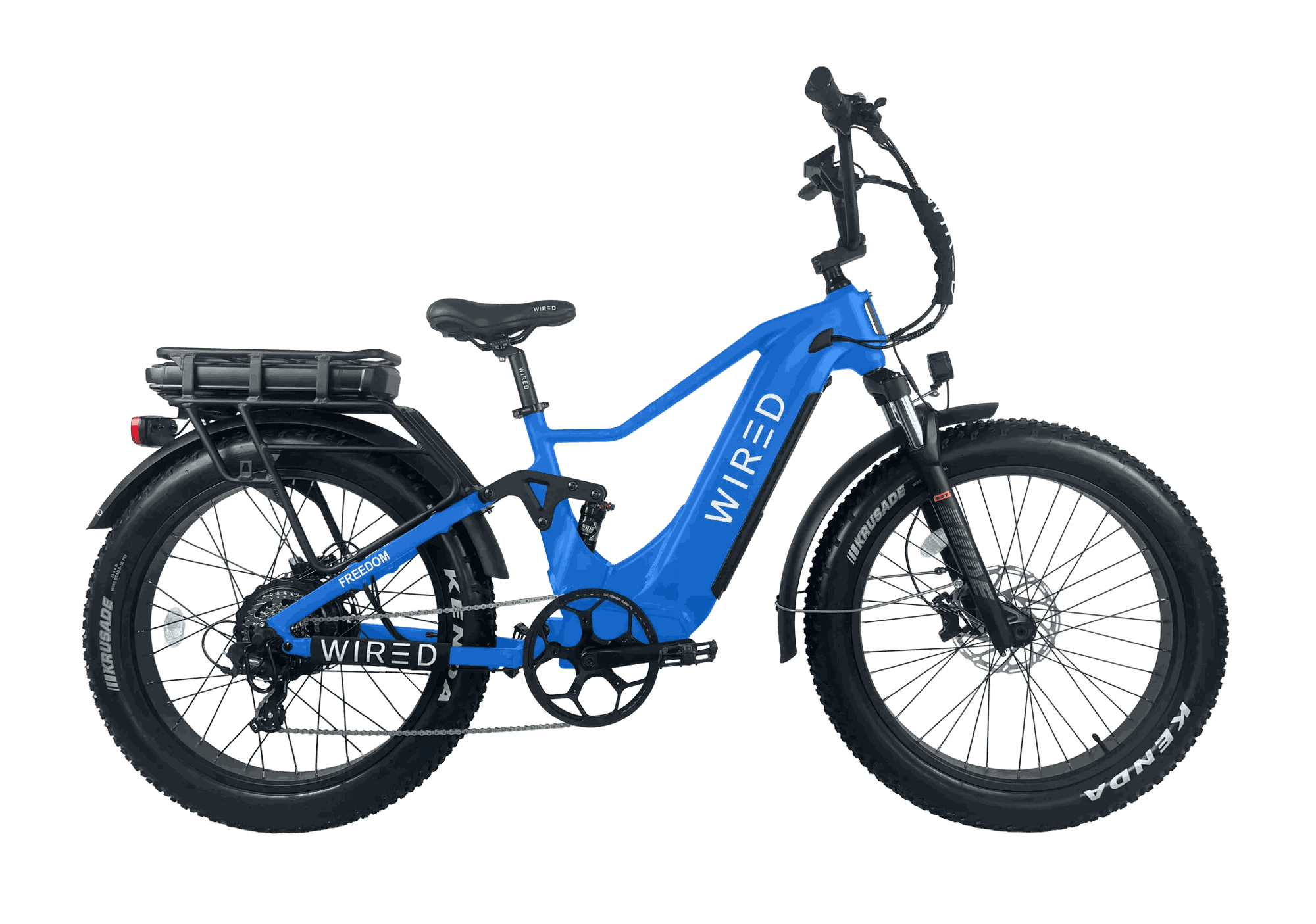
My take: it's a genuinely powerful, well-specced bike for the money if you want speed and don't mind the tradeoffs -- but I don't think it's the right bike for most 50+ riders looking for a stable, easy daily commuter. At $1,999, I found the Wired Freedom packs a 60V system with a claimed 3,200W peak motor, dual batteries totaling 2,100Wh, full suspension, and 4-piston hydraulic brakes -- specs that would cost far more from bigger brands. In my research, independent reviewers at Amped Cycle, TailHappyTV, and BikeRide.com all confirmed strong acceleration and genuine 40+ mph capability when unlocked. But those same reviewers flagged real concerns I want to pass along: the bike weighs roughly 105-115 lbs (sources vary), is nearly 78 inches long, and BikeRide's reviewers noted rear suspension bottoming out under heavier riders and reported handling issues including so-called 'death wobble' at speed (though TailHappyTV said they couldn't reproduce it). My read for a 50+ rider navigating hilly terrain and trail crossings is that this bike's weight, length, and moped-like power profile make it a harder, less forgiving ride than a Class 1 or 2 commuter or trail e-bike built for stability and easy handling.
- Motor: 60V, 1500W rated / up to 3,200W peak, geared hub motor
- Range: Manufacturer claims up to 90 miles on PAS Level 1; independent real-world testing by Amped Cycle…
- Weight: Reported inconsistently across sources
Five Questions to Ask Yourself Before Buying
- ⛰️ How much hill-climbing power do you really need? The Wired Freedom's 1500W, 153 Nm is the number that actually determines whether it stalls on a real grade — I'd check the Performance Notes below for how that held up in independent testing, not just the spec sheet.
- 🔋 What range do you actually need? 90 miles is advertised, but independent testing found 50 miles — I'd check the spec table and Battery & Range section for the full advertised-vs-real-world gap I found on this bike.
- 🏃 Can you handle a 115 lbs bike? At 115 lbs, lifting, folding, or carrying this bike is a real factor — I'd read the Physical Fit & Ergonomics section for what that means day to day.
- 🔊 What's the biggest trade-off on this bike? Heavy and long (roughly 105-115 lbs, ~78 inches) -- difficult to lift, transport, or maneuver at low speed — that's the top-listed con in my breakdown below; I'd decide up front whether it's a dealbreaker for how you'd actually use this bike.
- 🌿 What's this bike's strongest feature? Exceptional power and acceleration for the price ($1,999), confirmed by multiple independent reviewers — that's the top pro I found below, and I'd say it's the feature most worth cross-checking against your own priorities.
Performance Notes
How fast is the Wired Freedom really?
Fast enough to demand real caution, in my view. The bike ships configurable to Class 1, 2, or 3 settings, defaulting to a 20 mph Class 2 mode. In my research, independent testers confirmed that unlocked, the Freedom will genuinely hit 35-41+ mph depending on the review -- well above typical e-bike speeds. I'd point you to the Legal Status in Oregon section below for how those numbers compare to Oregon's e-bike class definitions.
How does it handle steep hills and rough pavement?
In my assessment, the full suspension helps, but the weight works against you. I found the RST front fork and DNM rear shock genuinely improve comfort over rough pavement, and reviewers I looked at praised the ride quality on that front. But at 105-115 lbs and nearly 78 inches long, this is a heavy, long bike to maneuver at low speeds, on inclines, or when walking it up a driveway or into a garage. I noted that BikeRide's reviewers specifically flagged the rear suspension bottoming out under heavier riders, which matters if you're carrying groceries or a passenger-style load on steep grades.
Is the battery range enough for real errands and rides?
In my read, it depends heavily on how you ride it. The manufacturer's 90-mile claim is based on PAS Level 1 (lowest assist), which most riders won't use most of the time. I found Amped Cycle's real-world test -- riding more aggressively -- got over 30 miles with 60% battery still remaining, which suggests a realistic total closer to 40-50 miles under mixed/harder use. For daily errands close to home, I'd say that's likely plenty, but I wouldn't plan around the 90-mile headline number unless you're riding gently in the lowest assist mode.
16-point spec sheet
| Motor | 60V, 1500W rated / up to 3,200W peak, geared hub motor (rear) |
|---|---|
| Torque | 153 Nm (per manufacturer) |
| Battery | Dual 60V batteries, 20Ah (frame) + 15Ah (rear rack), 2,100Wh total combined, Samsung 21700 cells, UL2271 certified |
| Frame | 6061 aluminum alloy, step-over (step-thru also offered) |
| Suspension | Full suspension -- RST Guide front fork (75mm travel) and DNM AO-8RC rear shock (190x50mm) with lockout |
| Tires | Kenda Krusade 26 x 4.0 inch fat tires |
| Drivetrain | 7-speed Shimano, 56T front / 11-34T rear |
| Brakes | 4-piston hydraulic disc brakes, 203mm rotors |
| Display | Full-color customizable LCD |
| Weight | Reported inconsistently across sources: manufacturer states 115 lbs with batteries (87 lbs without); independent reviewers reported 105 lbs (Amped Cycle) and 110.6 lbs (BikeRide) -- treat as approximately 105-115 lbs |
| Payload capacity | Not published by the manufacturer or confirmed by independent reviewers -- unconfirmed |
| Top speed | Configurable Class 1/2/3; 20 mph default Class 2 setting; 35-41 mph when unlocked (varies by source) -- see Legal Status in Oregon below |
| Range | Manufacturer claims up to 90 miles on PAS Level 1; independent real-world testing by Amped Cycle suggested closer to 40-50 miles total on the dual-battery setup under mixed use |
| Included features | Dual battery system, full suspension, hydraulic brakes, programmable display, USB charging port, cruise control |
| Warranty | 1 year from delivery date, original purchaser only, non-transferable; covers frame, motor, controller, display, and electrical sensors; battery covered on a 1-year pro-rated basis (customer pays return shipping); water/rust/neglect damage excluded |
| MSRP | $1,999 (per manufacturer as of research date; noted 'temporary tariff relief' pricing may change) |
Legal Status in Oregon
In my research, Oregon defines e-bike classes under ORS 801.258: Class 1 and Class 2 e-bikes are capped at a 750W nominal motor and a 20 mph top speed (pedal-assist for Class 1, throttle-assisted for Class 2), while Class 3 e-bikes allow pedal-assist up to 28 mph, still within that same 750W nominal motor cap. The Wired Freedom's motor is rated at 1,500W nominal with a claimed peak of 3,200W and 153 Nm of torque -- figures that exceed the 750W nominal motor cap Oregon's statute defines for any of the three e-bike classes. In its default Class 2 setting, the bike runs at a 20 mph top speed, which falls within Oregon's Class 2 speed limit. I confirmed with independent testers at Amped Cycle, TailHappyTV, and BikeRide.com that unlocked, the bike will reach 35-41+ mph depending on the review -- a top speed that exceeds both the 20 mph throttle-assisted cap for Class 1/2 and the 28 mph pedal-assisted cap for Class 3. My takeaway: the Freedom's stock, class-compliant configuration sits within Oregon's speed limits, but its motor's rated wattage and its unlocked top speed both exceed what Oregon's e-bike statute defines as an e-bike, putting the unlocked configuration outside those class definitions.
Pros and cons
✅ Pros
- Exceptional power and acceleration for the price ($1,999), confirmed by multiple independent reviewers
- Genuine full suspension (adjustable front fork + rear shock with lockout), not a token setup
- 4-piston hydraulic disc brakes with large 203mm rotors provide strong stopping power
- Dual-battery system (2,100Wh total) gives real flexibility to swap or run one pack for lighter trips
- Large 4-inch fat tires and UL2849/UL2271 safety certifications
- Step-thru frame option available for easier mounting
❌ Cons
- Heavy and long (roughly 105-115 lbs, ~78 inches) -- difficult to lift, transport, or maneuver at low speed
- Unlocked top speed (35-41+ mph) exceeds Oregon's e-bike class speed caps (see Legal Status in Oregon), and running it at legal Class 2/3 speeds means you're not using most of its rated power
- Real-world range falls well short of the marketed 90-mile figure under normal/harder riding
- Reported handling quirks at high speed ('death wobble') by at least one reviewer, disputed by another -- unresolved
- Only a 1-year warranty, with battery coverage capped at 1 year and customer-paid return shipping
- Small, direct-to-consumer brand with limited company/support transparency compared to larger e-bike makers
Frequently asked questions
Is Wired Ebikes a legitimate, established e-bike company?
Yes -- in my research, Wired Ebikes (wiredebikes.com) is a real, currently operating e-bike manufacturer that sells direct-to-consumer via its own site. It's a smaller, niche brand compared to companies like Rad Power or Aventon, and I noticed independent reviewers flagged that the company provides limited public information about its history, location, and support infrastructure. I'd encourage anyone considering a purchase to review Wired's own warranty and return policies directly before buying.
Is the Wired Freedom legal to ride on Oregon bike paths and roads?
In my assessment, it depends on how it's configured. In its default Class 2 setting (20 mph), it sits within Oregon's e-bike class limits. Unlocked, it can reach 35-41+ mph and its motor is rated well above Oregon's 750W nominal cap -- figures that fall outside Oregon's ORS 801.258 e-bike class definitions. I'd point you to the Legal Status in Oregon section above for the full comparison.
How does the Wired Freedom compare to a typical Class 2 commuter e-bike for someone over 50?
In my view, it's a very different kind of bike. The Freedom is built around raw power and speed -- a 3,200W peak motor and 2,100Wh of battery -- packaged into a heavy, long, moped-style frame. A typical 50+ commuter or trail e-bike prioritizes stability, easier handling, lighter weight, and predictable low-speed control, especially on hilly terrain. If your priority is a comfortable, easy-to-handle daily rider rather than top-end speed, I'd say this specific model is worth comparing carefully against lighter, more stability-focused options before deciding.
What does the warranty actually cover?
In my read of Wired's own warranty page, coverage is 1 year from delivery, non-transferable to a second owner. It covers the frame (with exceptions for misuse), motor, controller, display, and electrical sensors. The battery is covered on a pro-rated basis for that same 1 year, but the customer pays return shipping, and damage from water, rust, neglect, or improper charging is excluded.
Sources & further reading
- Wired Ebikes - Official Wired Freedom Product Page — Primary manufacturer specs: motor, battery, suspension, brakes, weight, and pricing.
- Wired Ebikes - Official Warranty Page — Confirmed 1-year warranty terms, battery pro-rated coverage, and exclusions.
- Amped Cycle - 2024 Wired Freedom Review — Independent hands-on review with real-world range testing, weight (105 lbs), and pros/cons.
- BikeRide.com - Wired Freedom Expert Review (77/100) — Independent aggregated expert review flagging weight, legal concerns when unlocked, and suspension bottoming-out issues.
- TailHappyTV - Wired Freedom Ebike Review — Independent owner/reviewer perspective, published October 21, 2024; disputes 'death wobble' claims and notes legal concerns when unlocked.
- Scott Hardesty - 2025 Wired Freedom — Independent written review of this exact bike model on Scott Hardesty's own site.