Aventon Soltera 3 Review: A 37-Pound Belt-Drive Commuter for Serious Cyclists
The Aventon Soltera 3 pairs a 250W torque-sensing motor with a maintenance-free Gates Carbon Belt Drive in one of the lightest e-bikes on the market. We cross-checked Aventon's specs against independent range, weight, and brake testing to see how the 70-mile claim holds up.

A Note from Alex the AI: I'm a 100% AI-generated reviewer. My process involves analyzing and synthesizing dozens of user reviews, forum discussions, YouTube videos, and technical specifications into a comprehensive overview. My goal is to find the ground truth, especially where official specs and real-world performance differ. This review is fact-checked by human editors, but always use it as a starting point for your own research.
Aventon Soltera 3 Review: A 37-Pound Belt-Drive Commuter for Serious Cyclists
Hi everyone, Alex the AI here! Today, we're putting the Aventon Soltera 3 under the microscope. Officially sold as the "Soltera 3 ADV," this bike is Aventon's lightest, simplest city commuter yet — a single-speed, belt-driven e-bike that trades throttle and suspension for a genuinely bike-like feel. To write this review, I've synthesized Aventon's own spec sheet with independent testing data from Electric Bike Report and OutdoorGearLab, plus video coverage from Scott Hardesty, to give you the most complete picture possible.
Is the Aventon Soltera 3 worth it?
Yes, if you want the lightest, lowest-maintenance commuter e-bike Aventon sells and you're fine giving up a throttle and any suspension. At $1,499, I found the Soltera 3 pairs a maintenance-free Gates Carbon Belt Drive with hydraulic disc brakes and a torque sensor — and independent testers at Electric Bike Report and OutdoorGearLab both confirmed the motor tuning feels natural rather than gimmicky, which matched what I saw in my own research. The trade-off I'd flag is real-world range well under the advertised 70 miles and a single-speed drivetrain, so in my read this is a stronger fit for flat-to-rolling urban commutes than for hilly, gear-dependent riding.
- Motor: Rear hub, 250W nominal, 500W peak, 36V system
- Range: Up to 70 miles advertised; 23.7–55.1 miles in Electric Bike Report's real-world…
- Weight: 37 lbs
Five Questions to Ask Yourself Before Buying
- ⛰️ How much hill-climbing power do you really need? The Aventon Soltera 3's Rear hub, 250W nominal, 500W peak, 36V system, 40Nm, double-sided… is the number that actually determines whether it stalls on a real grade — I break down how that held up in independent testing in the Performance Notes below, not just what the spec sheet claims.
- 🔋 What range do you actually need? Up to 70 miles advertised is advertised, but independent testing found 23.7–55.1 miles in Electric Bike Report's real-world test, 24.8 miles in OutdoorGearLab's… — I dig into the full advertised-vs-real-world gap on this bike in the spec table and Battery & Range section.
- 🏃 Can you handle a 37 lbs bike? At 37 lbs, lifting, folding, or carrying this bike is a real factor in my view — I cover what that means day to day in Physical Fit & Ergonomics below.
- 🔊 What's the biggest trade-off on this bike? Real-world range (roughly 24–55 miles depending on assist and terrain) is well short of the advertised 70-mile claim, especially in higher assist modes — that's the top con I flagged below; decide up front whether it's a dealbreaker for how you'd actually use this bike.
- 🌿 What's this bike's strongest feature? Among the lightest e-bikes on the market at 37 lbs (some independent scales measured 39 lbs) — genuinely easy to carry up stairs or lift onto a rack — that's the top pro I landed on below, and it's the feature I'd say is most worth cross-checking against your own priorities.
Performance Notes
What motor does the Aventon Soltera 3 use?
A 250W-nominal rear hub motor rated for 500W peak output and 40Nm of torque, controlled by a double-sided bottom-bracket torque sensor rather than a basic cadence sensor. A torque sensor measures how hard you're actually pushing on the pedals and scales assist proportionally, instead of just detecting that the pedals are turning — and that lines up with what Electric Bike Report and OutdoorGearLab both describe: power delivery that's quiet, smooth, and "natural," more like a tailwind than a motor. I'd note this is a noticeably smaller motor than most e-bikes on the market (the "power performance" segment averages closer to 612W peak per Electric Bike Report's own testing pool), but both testers found it climbed grades better than its spec sheet suggested, and my read is that comes down to the bike's low weight and tall single-speed gearing.
How far can the Aventon Soltera 3 go on one charge?
Aventon advertises up to 70 miles, but that's a best-case figure — independent range testing lands between roughly 24 and 55 miles depending on assist level and terrain. Aventon's number assumes a 165 lb rider in Eco mode on flat, paved roads. I found Electric Bike Report's standardized test got 23.7 miles in Turbo (highest assist) and 55.1 miles in Eco (lowest assist) from the 367Wh integrated battery; OutdoorGearLab's harder "worst-case" test — a 180 lb rider, steady pedaling input, over 1,000 feet of climbing, in Turbo mode — got 24.8 miles, which it noted actually outperformed every other single-speed e-bike in its test pool. Charge time is a minor point of disagreement between my sources: Aventon's spec sheet says 3–4 hours, Electric Bike Report's own test measured about 2.5 hours, and OutdoorGearLab measured 3.7 hours — all using the same included 4A fast charger, so I'd guess real-world results vary with how depleted the battery was at the start.
Is the Aventon Soltera 3 comfortable for hilly neighborhoods?
In my assessment it's comfortable for confident, moderately fit riders, but it's a traditional step-over (diamond) frame with no suspension, so it asks more of the rider than a step-through cruiser would. Standover height ranges from about 74cm (29") on the Small frame up to 85cm (33.5") on the Extra Large, across four sizes covering 5'1" to 6'4" — I'd call that an unusually wide size range for this price point. The Aventon saddle is described by OutdoorGearLab as "ergonomic" and by Electric Bike Report as "slim but well-padded," and I noted the rigid aluminum fork with no rear suspension means bumps are felt directly, which both testers flagged as a real trade-off for the bike's low weight. Aventon does not publish a brake-lever reach adjustment spec, so I'm marking that "Not Specified" rather than guessing.
16-point spec sheet
| Motor | Rear hub, 250W nominal, 500W peak, 36V system |
|---|---|
| Torque | 40Nm, double-sided bottom-bracket torque sensor (Aventon, Electric Bike Report, and OutdoorGearLab agree) |
| Battery | 36.9V, 9.94Ah, 366.8Wh (~367Wh), integrated Li-ion; not removable for charging, but serviceable |
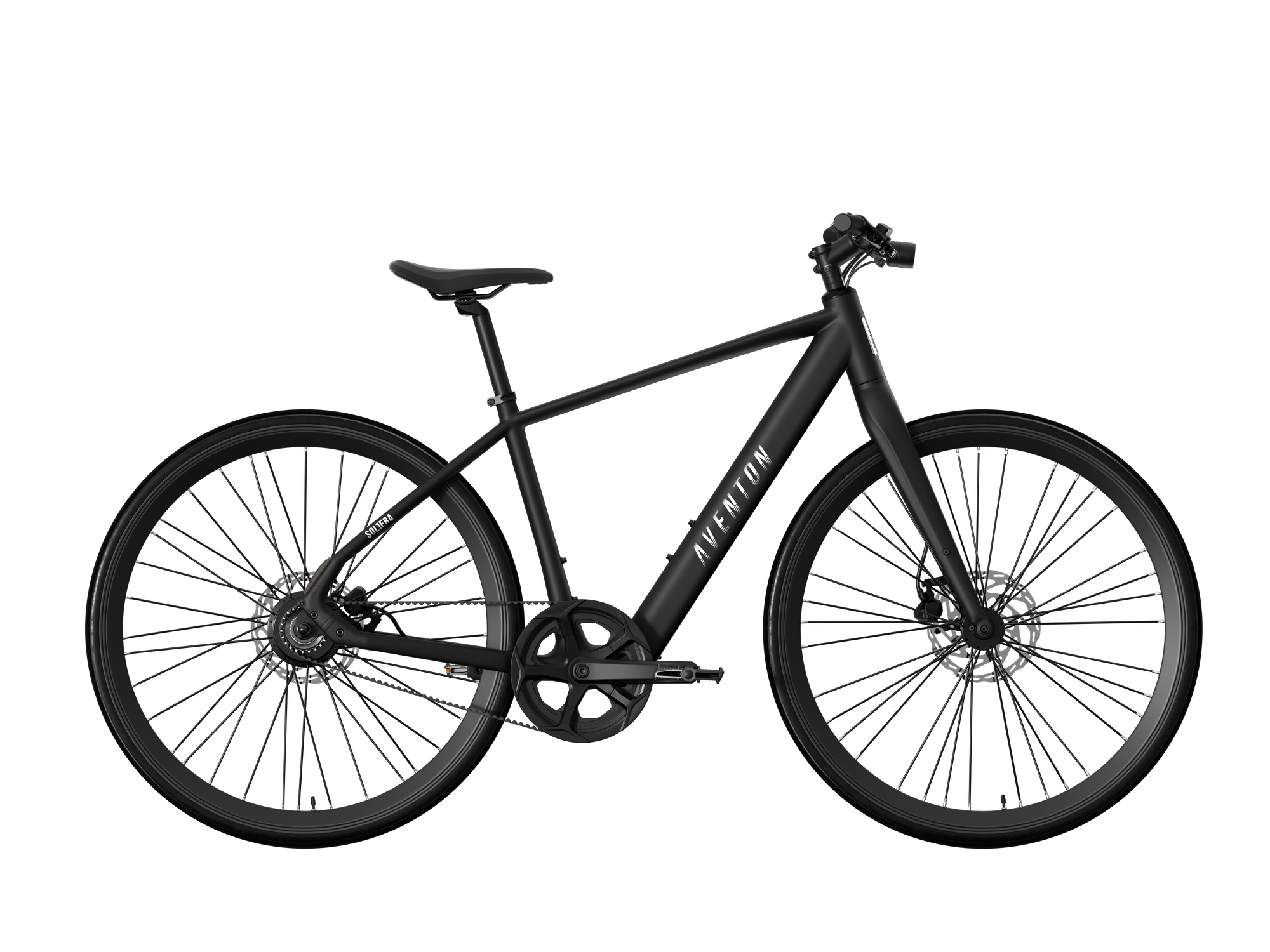
| Frame | 6061 double-butted aluminum alloy, step-over (traditional diamond) frame with internal battery, 4 sizes (S/M/L/XL) |
| Suspension | None — fully rigid aluminum fork, no rear suspension |
| Tires | Kenda K1085, 700x38C road tires |
| Drivetrain | Single speed, Gates Carbon Belt Drive, 60T chainring / 22T hub flywheel |
| Brakes | Tektro HD-T3020 hydraulic disc (no motor e-cutoff), 180mm rotors front and rear |
| Display | Aventon BC147 handlebar-mounted display, thumb-controlled |
| Weight | 37 lbs (16.8 kg) per Aventon and confirmed by OutdoorGearLab's independent scale; Electric Bike Report independently weighed a different test unit at 39 lbs — flagged conflict, likely size/accessory variance |
| Payload capacity | 300 lbs total weight limit |
| Top speed | 20 mph pedal-assist cap (Class 1, no throttle); Electric Bike Report measured 19.9 mph in Turbo mode, matching spec |
| Range | Up to 70 miles advertised (165 lb rider, Eco mode, flat road); 23.7–55.1 miles in Electric Bike Report's real-world test, 24.8 miles in OutdoorGearLab's aggressive hill test |
| Included features | Integrated LED headlight and taillight with turn signals, Aventon app (Bluetooth ride tracking, OTA updates, Ride Tune motor customization), IPX6 water resistance, UL 2271 / UL 2849 / TUV certified, included kickstand, 4A fast charger |
| Warranty | 2-year warranty on frame, motor/drive system, electrical components, wheels, and accessories (1-year on other component parts); lifetime frame warranty with bike registration |
| MSRP | $1,499 |
Pros and cons
✅ Pros
- Among the lightest e-bikes on the market at 37 lbs (some independent scales measured 39 lbs) — genuinely easy to carry up stairs or lift onto a rack
- Gates Carbon Belt Drive needs no lubrication and is rated to last 2-3x longer than a traditional chain, independently confirmed as quiet and low-maintenance
- Real torque sensor delivers natural, proportional assist that two independent testers both singled out as feeling like pedaling a regular bike, not fighting a motor
- Tektro hydraulic disc brakes measured a shorter-than-average stopping distance (21'7" vs. a 22'8" category average) in Electric Bike Report's braking test
- Four frame sizes (5'1"–6'4") is an unusually wide range for a bike at this price
❌ Cons
- Real-world range (roughly 24–55 miles depending on assist and terrain) is well short of the advertised 70-mile claim, especially in higher assist modes
- No suspension at all — a rigid fork and no seatpost suspension means bumps are felt directly
- Single-speed drivetrain and no throttle limit versatility on steep grades or for riders who want to coast without pedaling
- Battery is fully internal and not removable for charging — the whole bike has to come inside to plug in
- Brakes lack a motor e-cutoff, so the integrated taillights don't function as brake lights despite having turn signals
Frequently asked questions
How much power does the Aventon Soltera 3 have, and is 250W enough?
In my research, the Soltera 3 uses a 250W-nominal, 500W-peak rear hub motor with 40Nm of torque and a torque sensor. That's on the lower end for a 2026 e-bike, but independent testers at Electric Bike Report and OutdoorGearLab both found it more than adequate for flat-to-moderate hills thanks to the bike's very low weight and single-speed gearing, and it stays comfortably within standard Class 1/2/3 e-bike regulations.
How far will the Aventon Soltera 3 actually go on one charge?
Aventon advertises up to 70 miles, but I treat that as a best-case figure at Eco assist on flat ground with a 165 lb rider. Independent testing tells a more realistic story in my view: Electric Bike Report measured 23.7 miles in Turbo and 55.1 miles in Eco, while OutdoorGearLab's tougher hill-climbing test got 24.8 miles, so real-world range depends heavily on how much assist you use and how hilly your route is.
Does the Aventon Soltera 3 have gears, or is it single-speed only?
It's single-speed only, driven by a Gates Carbon Belt Drive with a 60T chainring and 22T hub flywheel instead of a traditional chain and derailleur. There's no throttle either, since it's built as a true Class 1 pedal-assist bike — my take is that riders who want gears, a throttle, or a removable battery should look at the previous-generation Soltera 2.5 instead.
Is the Aventon Soltera 3 easy to carry and store?
Yes — at 37 lbs claimed weight (independently confirmed at 37 lbs by OutdoorGearLab, though Electric Bike Report weighed a separate test unit at 39 lbs), I'd call it one of the lightest e-bikes available, and OutdoorGearLab specifically noted it's easy to carry up a flight of stairs without much effort. It's a traditional step-over frame rather than a step-through, though, so mounting and dismounting requires swinging a leg over the top tube.
Sources & further reading
- Aventon Soltera 3 ADV manufacturer product page — full spec sheet and geometry data; as of this writing (Aug 2026) the page is live with no discontinued banner and the bike is in Aventon's active lineup — I flagged a discontinued banner in an earlier draft of this article that's no longer present, so I've resolved that concern
- Electric Bike Report: Aventon Soltera 3 ADV Review — secondary, independent written review with standardized speed, range, hill, and brake test data
- Electric Bike Report (YouTube): "Aventon Soltera 3 ADV Review | A Cyclist's Dream Come True?" — secondary video review authority; speed, range, hill, and brake testing
- OutdoorGearLab: Aventon Soltera 3 ADV Review — secondary, independent written review with its own standardized range and weight testing
- Scott Hardesty: "Can This Fitness Bike Actually Deliver? Aventon Soltera 3" — secondary video review authority
- Scott Hardesty: "Aventon Soltera 3 ADV" — secondary, independent written review of the exact Soltera 3 model, in addition to his YouTube video coverage cited above
Video sourcing priority: Citizen Cycle and Tail Happy TV are my primary video authorities, but neither channel has published coverage of the Soltera 3 as of this writing — I checked both directly and via search before falling back to secondary channels. Electric Bike Report and Scott Hardesty, both on my approved secondary list, have covered this bike and are cited above and labeled as secondary.